
There’s a moment that most people who take their artwork seriously eventually reach: standing in a homewares store, frame in hand, realising that nothing on the shelf is quite right. The proportions are off, the finish doesn’t suit the piece, the glass is too reflective, or the available sizes force a compromise on something that shouldn’t be compromised.
That moment is usually when the idea of custom frames enters the picture properly — not as a luxury, but as a solution to a real problem.
Custom photo framing is often misunderstood as the expensive option for people who care too much about décor. The reality is more practical than that. It’s the option that exists because artwork doesn’t come in standard sizes, because rooms have specific requirements, and because some pieces simply matter enough to be done properly.
What custom framing actually means
The term ‘custom framing’ is used loosely, and it’s worth understanding what it does and doesn’t cover.
True custom framing means the frame is built to the exact dimensions of the artwork — not selected from a range of standard sizes and adjusted. The timber moulding is cut, joined, and finished to order. The mat board is cut to the exact opening required. Every component is specified for the individual piece.
This matters because even small dimensional differences have visible consequences. A frame that’s slightly too large for its artwork will show a gap between the mat and the rebate. A mat opening that’s even slightly off-centre will be obvious to the eye, even if the viewer can’t immediately identify why the piece looks wrong.
It also means you have genuine control over every element: the frame profile and finish, the mat colour and width, the glass type, the backing material, and any additional features like double matting, linen liners, or fabric-covered backing boards.
The scenarios where custom framing is clearly worth it
The artwork has sentimental or financial value
Original paintings, limited edition prints, vintage photographs, commissioned works, and any artwork passed down through a family fall into this category. These are pieces you intend to keep for decades, possibly generations. Using off-the-shelf framing with standard glass, acidic mat board, and a frame that doesn’t properly fit the work puts that longevity at risk.
Conservation-quality custom framing uses acid-free materials throughout, UV-filtering glazing, and construction that seals the artwork against dust and humidity. The additional cost is trivial relative to the value of what’s being protected.
The dimensions are non-standard
A 40 cm × 55 cm photograph. A panoramic print that’s 120 cm wide. A piece of artwork on handmade paper with an irregular edge. Standard frame sizes don’t accommodate these, and attempting to make them fit always produces a visible compromise.
Bespoke custom picture frames built to the artwork’s exact dimensions solve this completely — no trimming, no gap-filling, no apologetic mat cutting to compensate for a frame that’s slightly the wrong size.
The artwork needs specialist mounting or presentation
Three-dimensional objects — medals, jerseys, memorabilia — require box frames with specific depth. Canvases require stretcher bars before framing. Delicate works on paper require conservation mounting techniques that don’t involve adhesive touching the surface. Embroideries, textiles, and needlework require specific backing and support methods.
These applications can’t be handled with off-the-shelf frames. They require a framer who understands the requirements of the specific object and builds the presentation accordingly.
The room has a specific look you’re working toward
When framing is being considered as part of a broader interior design decision — a renovation, a new build, a considered room styling — the ability to specify exactly the right profile, finish, and proportions matters. The difference between a frame profile that reads as exactly right in a particular space and one that’s slightly off is often the difference between artwork that integrates with a room and artwork that fights it.
Understanding frame profiles
The profile of a frame — its cross-sectional shape when viewed from the side — determines a great deal about how it looks and what it suits.
Flat profiles are clean and minimal. They lie flush with the artwork surface and suit contemporary spaces, photography, and any application where the frame should recede.
Stepped or rebated profiles have a graduated depth that creates a sense of shadow and dimension drawing the eye inward. A classic framing shape that suits traditional and formal presentation.
Ornate and moulded profiles have carved or relief detail. These are the profiles associated with traditional oil painting frames — gilded, deeply sculpted, with classical motifs. Appropriate for artworks with equivalent visual presence.
Deep or shadow box profiles provide a recessed interior space for three-dimensional objects. The depth of the rebate is the critical measurement.
Mat board: the element that shapes everything else
The mat has more influence on the overall look of a framed piece than any other single element, including the frame itself.
Width is the first consideration. Too narrow, and the artwork feels cramped. The general professional standard is a minimum of 6–8 cm on the sides and top, with the bottom mat slightly deeper — this bottom weighting compensates for a visual perception phenomenon where equal margins appear unequal to the eye.
Colour follows width. White and off-white are the most versatile choices. Coloured mats can be striking when they echo a tone present in the artwork itself, but when colour matching goes wrong, it pulls attention away from the image entirely.
Double matting — two layers with a narrow reveal of the inner mat colour — adds visual depth and a gallery-quality finish.
Material quality is non-negotiable for anything you intend to keep. Conservation-grade, acid-free mat board is the standard. Acidic mat board causes the artwork beneath it to yellow and degrade in a process called mat burn that cannot be reversed.
How to evaluate a framing studio
If you’re choosing a framer for a piece that matters, there are a few indicators of quality that are worth looking for.
In-house construction. Framers who build frames in their own workshop have direct control over every step. When work is sent to a third party for construction, that quality control disappears.
Conservation materials as standard. A good framer uses acid-free mat board, acid-free backing, and UV-filtering glazing as the baseline — not as premium add-ons.
Willingness to discuss the artwork. Before recommending any framing approach, a skilled framer should ask about the artwork, where it will hang, what the room looks like, and what result you’re hoping for.
Transparent process and timeline. Custom framing takes time — typically one to three weeks for a well-made piece. Framers who offer very fast turnaround times on custom work are usually cutting corners somewhere.
Common questions about custom framing
Can I bring an existing frame and have it re-matted or re-glazed?
Yes, in most cases. If the frame is in good condition but the glass has been damaged, the mat has yellowed, or the existing mat colour no longer suits the space, these components can be replaced independently.
What if I have multiple pieces to frame for the same room?
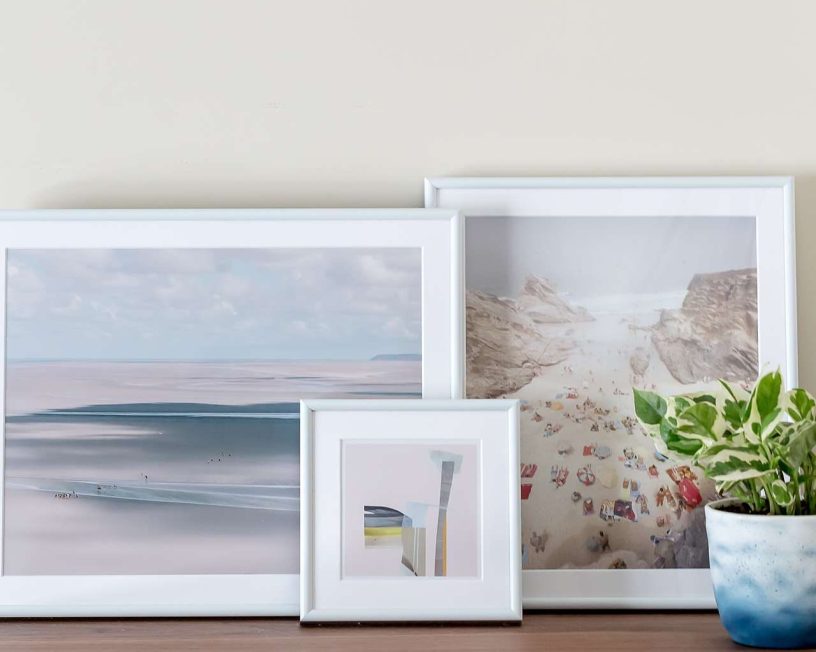
Framing a group of works for the same space is an opportunity to think about them as a system. Consistent mat colour across different frame finishes, or consistent frame finish across different mat colours, creates visual cohesion.
Conclusion
Custom framing isn’t a luxury — it’s a practical solution to the fundamental problem that artwork comes in every size and shape, while the available wall space and the specific requirements of each piece are equally varied.
When you invest in artwork that matters to you — whether that’s a commissioned painting, a significant photograph, a child’s first artwork you want to keep properly, or anything else that deserves to last — the framing is part of the investment. Done well, it protects the artwork for decades, presents it exactly as it deserves to be seen, and integrates it into your space in a way that looks considered rather than incidental.

