
Water has a way of making itself known at the most inconvenient times. The ceiling stain that appears the week before a major client visit. The spike in the water bill that shows up at the end of the quarter, long after the damage is done. The damp smell in a storeroom that turns out to be a slow pipe leak that’s been running behind the wall for months.
For commercial buildings in Perth, the challenge with water leaks isn’t that they’re impossible to find — it’s that the ones causing the most damage are often invisible until the situation is already serious. Commercial leak detection exists precisely to close that gap: to find water escaping from a building’s plumbing system before visible damage, structural deterioration, or tenant disruption forces the issue.
This guide covers how commercial leak detection in Perth works in practice, what signals should prompt an investigation, and why the timing of detection makes such a significant difference to the eventual repair cost.
Why commercial leaks are harder to detect than residential ones
In a house, a water leak is usually relatively straightforward to locate. The pipe network is simple, the building footprint is modest, and water doesn’t have far to travel before it shows itself. In a commercial building, none of these things are true.
Commercial buildings have extensive plumbing networks — often running through multiple floors, beneath thick concrete slabs, inside wall cavities, through plant rooms, and underground for significant distances. A slow leak in a pressurised supply line on level three might not present visibly on the floor below for weeks or months. By that point, the insulation, wall lining, and structural elements in between have been absorbing moisture continuously.
Perth’s sandy soils add another dimension for underground leaks. Unlike clay-heavy soils that retain surface moisture and make underground leaks easier to spot, Perth’s sandy ground absorbs and disperses leaked water quickly — meaning a slow underground supply leak can go undetected for extended periods based on surface observation alone.
The consequence is that commercial leak detection requires specialist technology and methodology, not just a visual inspection. The goal is to find water where it shouldn’t be, before it announces itself on the wrong side of a wall or ceiling.
The technology used in professional commercial leak detection
Modern leak detection technology has transformed what’s possible in a commercial building context. Where older diagnostic approaches often required exploratory excavation or destructive investigation to locate a fault, current methods can identify leak locations with high precision before any physical intervention is made.
Acoustic leak detection
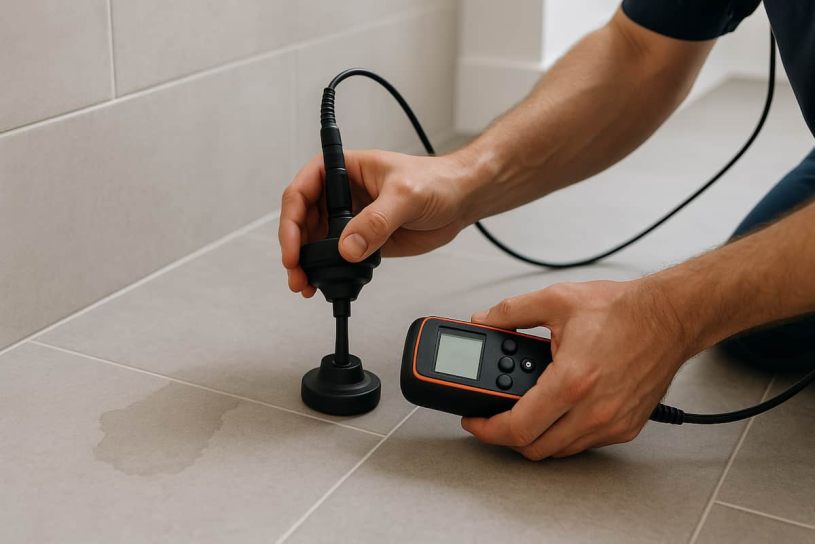
Water escaping from a pressurised pipe under the ground or behind a wall creates a characteristic acoustic signature — a hiss, vibration, or low-frequency sound that travels through the pipe material and surrounding structure. Specialist ground microphones and electronic listening devices amplify this signal, allowing a technician to trace its source and identify the fault location to within a small area.
Thermal imaging
Thermal cameras detect temperature differences in wall and floor surfaces. A slow leak behind a wall gradually changes the thermal profile of the affected material — the moisture-saturated zone shows up as a distinct colour on the camera display, even when the wall surface appears completely dry. This approach is particularly effective for hot water line leaks, where the temperature differential is more pronounced.
Tracer gas
For leaks that acoustic and thermal methods can’t locate precisely, tracer gas detection provides a definitive answer. A non-toxic gas is introduced into the pipe, and a sensitive surface detector is run along the pipe route. Gas escaping through the leak point rises to the surface and registers on the detector, pinpointing the fault location to within millimetres.
Pressure testing and flow analysis
Before physical investigation begins, pressure testing can confirm whether a leak exists and provide an indication of its severity. Isolating sections of the pipe network and monitoring pressure drop identifies which circuit is losing water — narrowing the investigation scope before specialist equipment is deployed.
Warning signs that should prompt a commercial leak detection inspection
You don’t need to see water to suspect a leak. Several less dramatic signals warrant professional investigation, and recognising them early is how you avoid the expensive end of the repair spectrum.
- A water bill that has increased without a corresponding change in occupancy or usage patterns
- The sound of running water when no fixtures are in use — in walls, under floors, or in plant rooms
- Warm or damp patches on floor surfaces, particularly tiled or concrete floors at ground level
- Unexplained damp smells in enclosed spaces — storerooms, under-stair areas, plant rooms, basement levels
- Unusually green or lush patches in landscaped areas that receive no extra watering
- Soft or subsiding ground near known pipe routes
- Staining on ceilings or internal walls, particularly appearing after a period of no rainfall
Any one of these signals on its own warrants at minimum a conversation with a commercial plumber. More than one occurring simultaneously should prompt a formal leak detection inspection without delay.
The cost argument for early detection
The financial case for investing in commercial leak detection in Perth is most clearly made by comparing two scenarios: the cost of detection and prompt repair versus the cost of the same leak discovered after months of undetected water damage.
Early detection means a repair confined to the actual fault — replacing a section of pipe, sealing a joint, addressing a fitting failure. Late detection means the same repair, plus professional drying of saturated building fabric, replacement of insulation, restoration of wall linings or floor coverings, potential mould treatment, and possible structural assessment. In serious cases, the remediation cost is an order of magnitude larger than the original repair.
Water loss has a direct financial dimension as well. A leak discharging one litre per hour adds more than 8,700 litres to your annual water consumption — at commercial Water Corporation rates, this is a meaningful operating cost. Multiple concurrent leaks in a large commercial building amplify this figure significantly.
Insurance considerations add another layer. Commercial building policies typically include maintenance obligations. A water damage claim arising from a fault that a routine inspection would have identified may face scrutiny over whether the building owner met their duty of care. A documented leak detection history provides the evidence base that protects against this outcome.
When to schedule commercial leak detection
There are two valid approaches to commercial leak detection: reactive (investigate when a symptom appears) and proactive (schedule periodic inspections regardless of visible symptoms).
Proactive detection is the stronger position for commercial buildings over 15 years old, buildings with a history of plumbing issues, buildings with high daily water consumption, and strata or multi-tenancy buildings where shared infrastructure serves many stakeholders. In these contexts, annual leak detection inspections form a sensible part of a broader maintenance programme.
For newer buildings or those with recent plumbing upgrades, reactive monitoring — maintaining awareness of water consumption trends and acting quickly on any of the warning signs listed above — may be sufficient, supplemented by pressure testing as part of annual maintenance visits.
In either case, the key is having a clear protocol and a reliable trade partner, so that when a concern arises, the response is prompt and professional rather than delayed while a contractor is sourced.
Conclusion
Commercial leak detection in Perth is one of those services that most building owners don’t think about until they wish they’d used it sooner. The technology exists to find leaks that would have been undetectable without excavation a generation ago — the only variable is whether building owners choose to use it before, or after, the water makes itself known.
For commercial properties in Perth, the sensible position is straightforward: understand the warning signs, act on them quickly, and build periodic leak detection into your maintenance programme for any building that carries significant age, complexity, or occupancy.

