
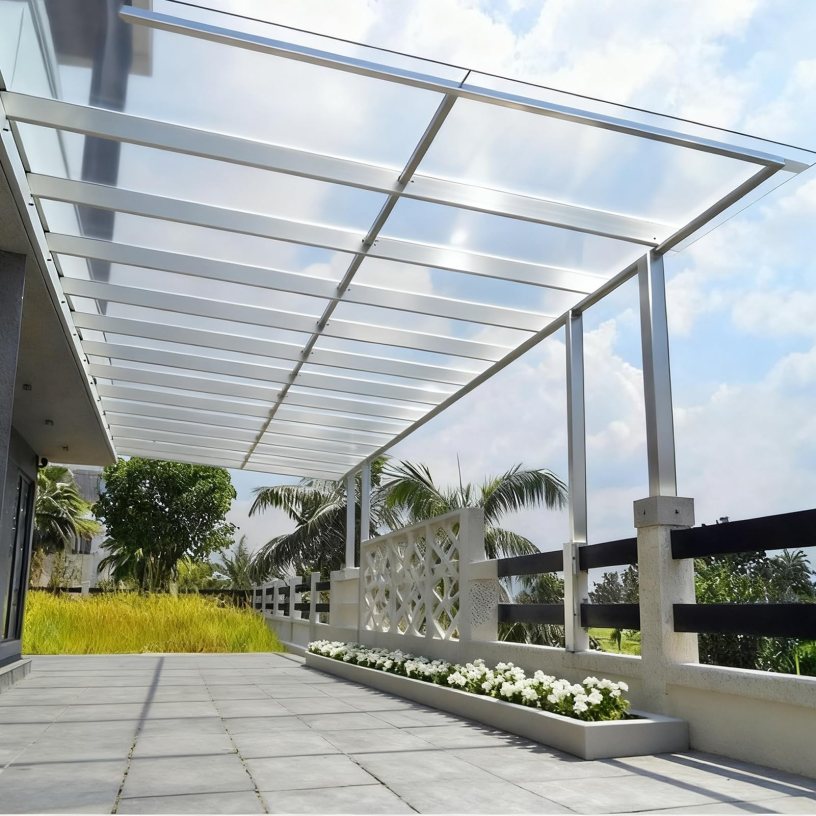
A fixed roof over an outdoor area has to do two jobs at once in this climate, and they pull in different directions. It must shed a hundred millimetres of rain in an hour without overflowing, and it must cut solar gain without turning the space beneath it into an oven. A roofing awning that manages both is mostly a matter of getting the pitch, the material and the drainage right, in that order.
Fixed Roofing Versus Retractable
Retractable systems suit spaces used occasionally, where the option of full sun matters and where the structure can be withdrawn ahead of bad weather. A fixed roof suits everything that must stay usable regardless, a car porch, a walkway between buildings, a kitchen yard, a rear service area. Fixed structures also carry loads that fabric cannot, span greater distances, and require no maintenance of moving parts. Where the area needs shelter every day, fixed is the correct answer and usually the cheaper one over ten years.
Polycarbonate
Multiwall and solid polycarbonate sheeting dominates residential work here for good reasons: it is light, it transmits daylight, it resists impact, and it is straightforward to install over a modest frame. Solid sheets are clearer and stronger; multiwall sheets insulate better because of the air cells and diffuse light more evenly. Both must be specified with a UV-protective layer, correctly oriented outward, or the material yellows and turns brittle within a few years. Rain noise is the main complaint, and it is genuinely loud during a downpour.
Metal and Composite Roofing
Aluminium composite panels, insulated sandwich panels and profiled metal sheets block light entirely, which is exactly what some spaces need. Insulated panels with a foam core are markedly quieter in rain and considerably cooler underneath than single-skin metal, which radiates heat downward all afternoon. Single-skin metal is the cheapest option and behaves like a griddle over an unventilated space. Where budget allows, an insulated panel over a seating or working area repays the difference immediately in usability.
Glass and Louvres
Tempered or laminated glass gives the cleanest appearance and the best light, at the highest cost and weight, and it needs cleaning to stay attractive. Adjustable aluminium louvre roofs are the most flexible option available, opening for ventilation and closing to shed water, but they cost several times a polycarbonate roof and add a mechanism to maintain. Both suit prominent locations where appearance justifies the expenditure rather than utilitarian service areas.
Pitch and Drainage Decide Performance
Most failures are water failures. A roof needs enough fall to move water quickly, gutters sized for tropical intensity rather than temperate rainfall, and downpipes discharging somewhere that will not flood. An insufficient pitch causes ponding, which finds every joint eventually. Overflowing gutters during a heavy storm are almost always undersized rather than blocked, though blockage from leaf litter compounds it. Ask what rainfall intensity the drainage has been sized for, and where the water actually goes.
Structure and Fixings
The frame carries wind uplift as well as dead weight, and uplift on a large flat surface is the load that pulls structures off walls. Aluminium frames resist corrosion and suit most residential spans. Steel is stronger for long spans and needs galvanising plus a proper coating to survive the humidity, particularly near the coast. What matters most is the fixing into the existing building: the substrate must be sound, the anchors correct for the material, and the penetrations sealed. This is where cheap installations fail, and it is invisible once complete.
Rain Noise Is Worth Planning For
Nobody thinks about acoustics until the first storm. A thin polycarbonate or single-skin metal roof over a small area produces a drumming loud enough to stop conversation, which matters if the space is a dining area or sits outside a bedroom window. Thicker sheets are quieter, insulated composite panels are quieter still, and a shallower pitch reduces the impact energy of each drop slightly. Where noise genuinely matters, ask the contractor to show you an existing installation in the same material rather than relying on a description.
Heat, Ventilation and Comfort
A sealed roof over a paved area traps hot air. Leaving a ventilation gap at the high edge, or using a partially open system, lets heat escape and makes a substantial difference to comfort. Light-coloured or heat-reflective finishes reduce absorbed heat. Consider the orientation too, since a west-facing space takes the worst of the afternoon sun and may need a side screen as well as a roof to be usable at all. Any competent awning roof design accounts for where the sun actually is.
Approvals and Building Rules
Structures at HDB properties are subject to approval, with specific requirements on what may be installed and where. Landed properties may require planning approval and, for anything of scale, submissions by a qualified person. Condominium residents need management approval, and facade uniformity rules often dictate the colour and profile. Check all of this before ordering, because an unapproved structure can be required to come down at your cost.
Choosing and Maintaining
Get itemised quotations naming the sheeting material and thickness, the frame section and finish, the fixing method, the gutter and downpipe sizing, and the warranty on each. Ask to see installations more than five years old rather than recent ones. Once installed, clear gutters twice a year and check fixings annually. Specified properly, a roofing awning is a fifteen-year structure that needs almost nothing beyond keeping the water path clear.

